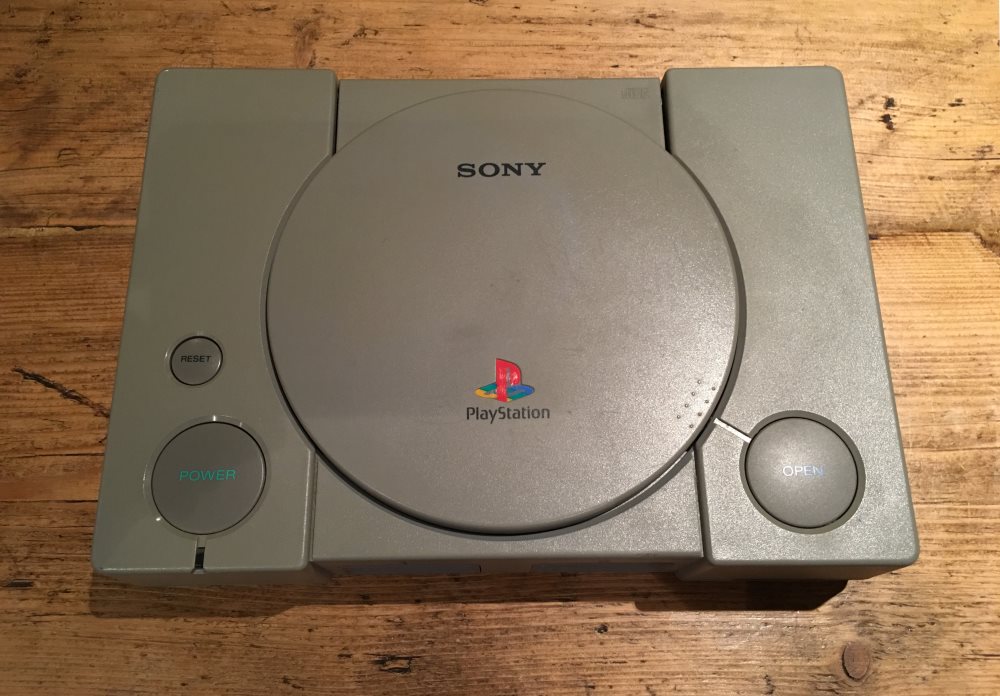
Sony PlayStation

Consoles, Sony PlayStation

Sony PlayStation console

The original Sony PlayStation is one of the defining game consoles of the 1990s. Released in 1994 in Japan and 1995 in Europe and North America, it pushed home gaming decisively toward textured 3D graphics, CD audio, and much larger game worlds than the cartridge-based machines it competed with.

For me, it still feels like a genuine turning point in game history. It is not just an important console on paper. It is a machine with a huge library, distinctive video output quirks, memorable controllers and accessories, and a strong case for being played on original hardware today.

Why the PlayStation is interesting

The PlayStation matters for a few reasons:

  • huge and varied software library
  • unusually strong early 3D catalogue
  • widespread support for quality arcade ports and quirky peripherals
  • analog-era accessories such as the NeGcon and PlayStation Mouse
  • simple, compact hardware that is still practical to hook up and capture

It also sits in a useful middle ground for retro projects. It is old enough to have clear hardware character, but common enough that consoles, controllers, memory cards, and cables are still relatively easy to find.

Core specifications

The original PlayStation hardware is built around:

  • CPU: MIPS R3000A-compatible processor at 33.8688 MHz
  • Media: CD-ROM
  • Video output: composite, S-Video, RGB, and region-dependent RF options
  • Audio: stereo output via AV multi-out
  • Controllers: digital pad, later Dual Analog and DualShock support
  • Storage: memory cards for saves

That specification is modest by modern standards, but it was more than enough to define a generation of 3D console gaming.

Why original hardware still makes sense

The PlayStation is very well emulated now, but there are still good reasons to keep the original machine around:

  • original video timing and output behaviour
  • perfect compatibility with original controllers and accessories
  • no need to second-guess emulator settings or latency
  • easy testing against MiSTer FPGA and other recreation hardware

That makes it a useful reference platform even if you also use emulation or FPGA solutions.

Video and display considerations

One of the things I find most interesting about the PlayStation is how much of the console’s character comes from its video output.

Key points:

  • many games were designed around CRT displays
  • image stability and dithering look different depending on whether you use composite, S-Video, RGB, or modern scaling
  • fast-moving 3D titles can reveal timing quirks and dropped-frame behaviour that are easy to miss in emulation

For capture and comparison work, that makes the PlayStation a surprisingly rich platform to study.

Controllers and accessories

The PlayStation also stands out because of its accessory ecosystem:

  • standard digital controllers
  • Dual Analog and DualShock revisions
  • memory cards
  • specialist accessories such as the PlayStation Mouse
  • specialist controllers such as the Namco NeGcon

These accessories are part of why the platform still feels distinctive today.

Learn more

Related posts and hardware notes:

Other Posts