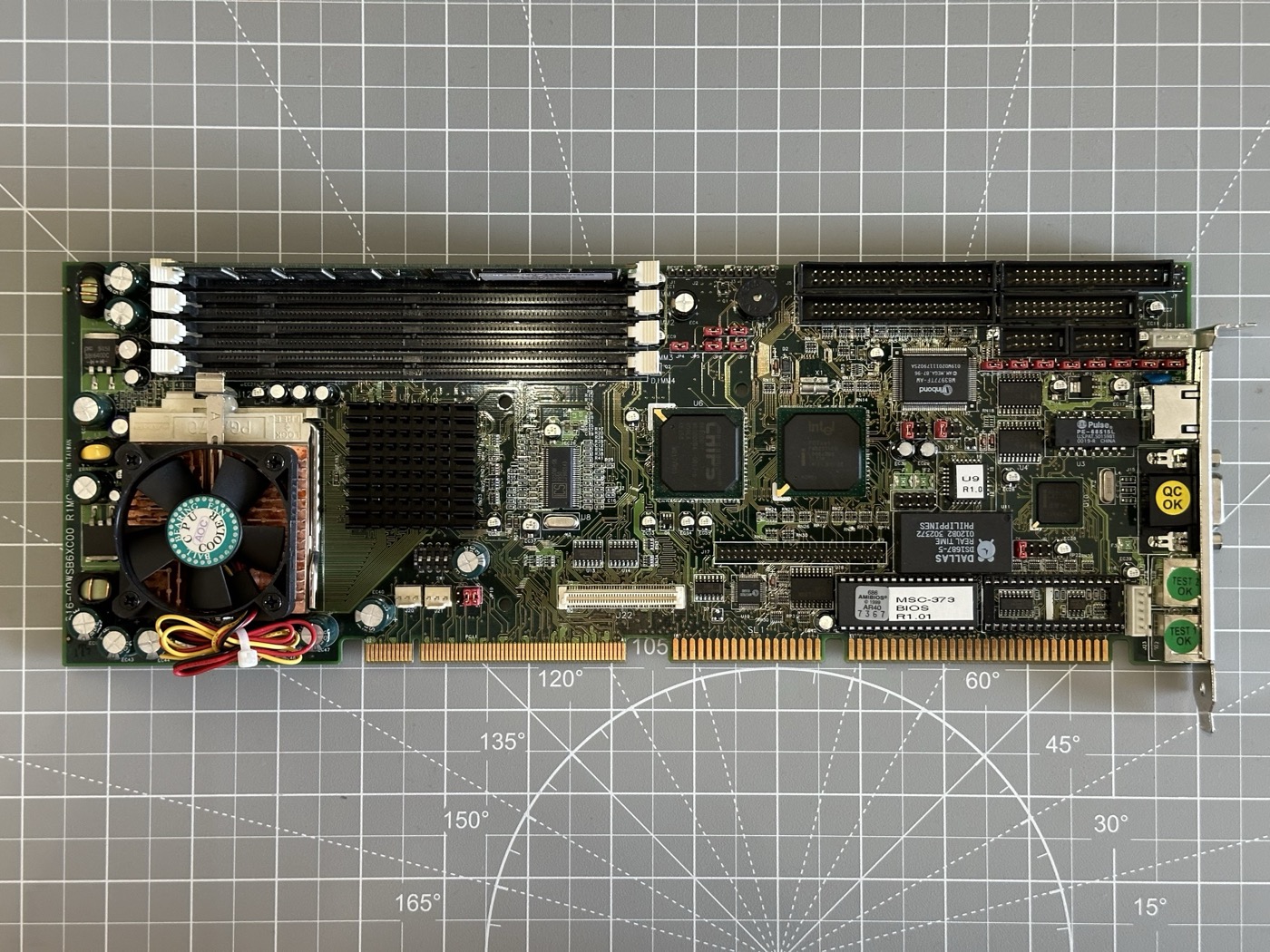
The MiTAC MSC-373 is an industrial single-board computer (SBC) — instead of a motherboard with a chipset and a CPU socket, the whole PC (chipset, CPU, RAM, graphics) is squeezed onto one long card that plugs into a passive backplane. I picked one up out of curiosity to see if an industrial board with no gaming pedigree could still make a fun DOS/Windows 98 machine — see This Fully Functional PC Fits on a Single Card!.
How PICMG passive-backplane PCs work
Unlike a normal PC, the backplane itself does almost nothing — it exists purely to (1) supply ATX/AT power to the SBC through the PICMG connector, and (2) break out the ISA and PCI buses into physical slots for add-on cards. The SBC plugs into a long PICMG 1.0 slot that’s really just a PCI connector and an ISA connector lined up next to each other. This gives a genuinely different repair model than a normal PC: if the machine dies, you don’t troubleshoot RAM vs. CPU vs. motherboard — you just swap the whole card for an identical one and you’re back running, with the peripherals in the backplane’s slots untouched.
Mine came paired with an MBP-PCI6R-ATX backplane: 4 ISA slots and 3 PCI slots, two of the PCI slots wired into the PICMG arrangement for the SBC itself.
Specifications
- Chipset: Intel 440BX
- CPU: Socket 370 (mine is a Pentium III)
- Memory: 4× DIMM sockets, PC100 SDRAM
- Graphics: onboard Chips & Technologies B69000
- Storage: 2× IDE, plus a floppy connector
- I/O headers: serial, parallel, USB
- Rear panel: 10/100 Ethernet, VGA, PS/2 keyboard and mouse
- Other onboard: PC speaker, real-time clock + CMOS battery, an unlabeled connector believed to be for an LCD panel
- Backplane interface: PICMG 1.0 (a combined ISA + PCI edge connector)
Setup notes
- Power jumper: the board supports both AT and ATX power — for an ATX single-board computer with an ATX supply, the on-board silkscreen guide calls for setting jumper 1 to position 2–3.
- No power button on the backplane — the power switch header is jumper J3; shorting it powers the system on.
- Unlabeled status LEDs: most likely per-rail power indicators — one general “power good” LED, then +5V, −5V, +12V, −12V, and +3.3V. The −5V rail reads as missing on a modern ATX supply, since ATX dropped −5V from the spec — harmless unless you’re running one of the small number of old ISA cards that specifically need it. (If you do, the Voltage Blaster project is a small ISA card that derives −5V from +5V for exactly this case.)
- No official documentation exists for this specific backplane model — the above was worked out by intuition and the printed jumper guide on the board silkscreen itself.
Where it fits
Genuinely capable as a DOS and Windows 98 machine — see the full writeup for performance numbers, sound testing, and a Voodoo 3 upgrade. The real appeal of the format is modularity: the same backplane and peripherals work with any PICMG 1.0 SBC, so swapping in a 386, 486, or a faster Pentium 4-class card is just a matter of pulling one board and pushing in another.
Related on this site
- This Fully Functional PC Fits on a Single Card! — my video on this board
- TheRetroWeb: MiTAC Trigon MSC-373
