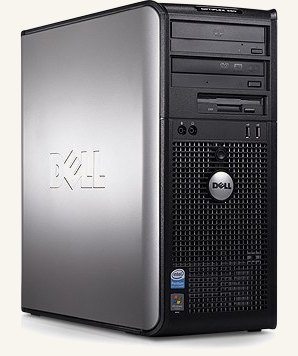
The Dell OptiPlex 760 looked like it should be a strong all-round retro PC: cheap Core 2 hardware, PCI and PCIe expansion, decent CPU performance, and just enough legacy friendliness to make experimentation worthwhile.
What I found was more mixed. The 760 can be coaxed into some very interesting places, but it is a much more awkward Windows 98 machine than it first appears. In the end, it feels far better suited to Windows XP and DOS than to a clean “one box does everything” Win98 dream build.
For the broader hardware overview, see the companion page for the Dell OptiPlex 760; the running project notes track where the build is up to.
Hardware Overview
The important details for this experiment were:
- Intel
ICH10controller hub - Analog Devices
AD1984Aaudio codec - no convenient BIOS option like the OptiPlex 380’s OS install mode to cap RAM
That missing RAM-limiting feature makes Windows 98 setup harder straight away.
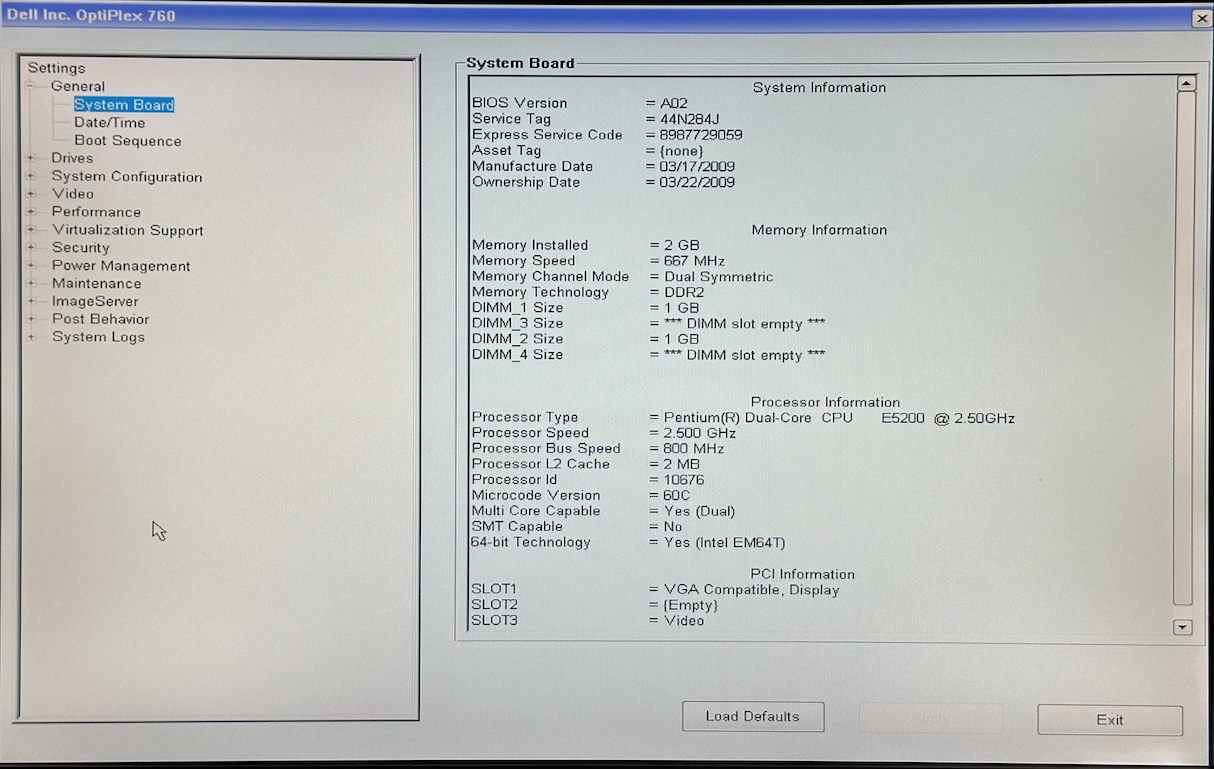
My specific machine is not a maxed-out 760 either. It is a fairly ordinary office-spec box:
- BIOS: A02
- CPU: Pentium Dual-Core
E5200 @ 2.50GHz - Bus speed: 800MHz
- L2 cache: 2MB
- Memory: 2GB DDR2 at 667MHz
- Memory layout: 1GB in DIMM 1 and 1GB in DIMM 3, running in dual-channel symmetric mode
That makes the results more interesting, because this is much closer to the kind of machine you might actually pick up cheaply rather than some fully upgraded ideal configuration.
Why I Thought It Might Work
At a glance, the 760 has a few things going for it:
- fast late-Core-2 performance
- enough expansion for graphics and sound experiments
- a motherboard serial header that helps with legacy input
- PCIe graphics options that, in theory, could make for a very powerful Win98/XP crossover system
That was enough to make it worth a proper test.
First Test: Can Windows 98 Boot at All?
Rather than start with a clean install immediately, I did a fast and slightly messy sanity check:
- move over an existing Windows 98 hard disk from the Dell Dimension E520
- disable some modern CPU features such as multicore, SpeedStep, and C-states
- see how far the system gets
That is not a clean method, but it is a quick way to answer the first question: is the platform even remotely viable?
The answer was: yes, sort of.
Windows 98 did boot. That alone was enough to keep digging.
The Good News: Radeon X600 Worked
One of the first pleasant surprises was graphics.
The Radeon X600 installed quickly and worked well with Catalyst 6.2 drivers, including Direct3D acceleration.
That matters because PCIe-era Windows 98 graphics support can be fragile, and some of these later Radeon cards sit right on the edge of “supported in theory” and “stable in practice.”
For a moment, it looked like the 760 might become a very capable late Win98 machine.
The Big Problem: Voodoo 2 Fell Apart
This is where the experiment stopped looking easy.
The moment I tried to bring in a Voodoo 2, the platform became much less convincing. What I got was repeated crashes, FXMEMMAP blue screens, and dos/4gw protection faults in DOS.
I stripped the machine back to a minimal hardware set and disabled onboard devices, but the behaviour did not improve.
At that point, the working theory became:
- memory mapping conflicts
- chipset-level incompatibility
- or BIOS restrictions that are hard to work around without deeper modding
Whatever the exact root cause, the practical conclusion is the important part:
the OptiPlex 760 does not look like a good Voodoo 2 platform.
The Other Problem: Onboard Win98 Audio Is Still Unresolved
The onboard Intel HD Audio is also awkward under Windows 98.
The onboard Intel audio is not officially supported on Windows 98. The WDMHDA project gets part of the way there — the driver installs, but I got no actual audio output. Codec support for this Analog Devices AD1984A just isn’t there yet; there’s a Vogons thread worth watching if you’re tracking that project.
So while the driver situation is interesting, it is not yet a solved path for this machine.
Windows XP
Windows XP is where the 760 starts to make much more sense. Chipset drivers install cleanly, performance is excellent, and faster GPUs like the Radeon 4670 become practical.
If the goal is a cheap, fast, low-drama retro machine for early-2000s PC gaming, XP is probably the best reason to use this hardware at all.
Windows 7
Windows 7 works, but performance is underwhelming without more RAM or an SSD.
That probably makes it less interesting than XP for this specific project.
DOS
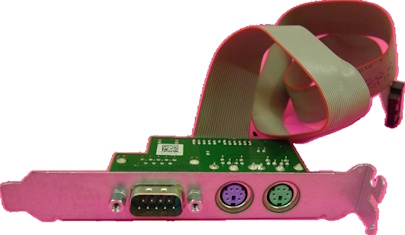
DOS support is much better than expected. The motherboard has a serial header, and adding a proper bracket to run PS/2 keyboard and mouse off it cleared up the USB-keyboard headaches. SBEMU works well for sound.
The serial / PS2 header arrangement is the same style I used on the OptiPlex 380:
That gives the machine an interesting split personality:
- awkward for a “pure” Win98 nostalgia build
- surprisingly useful for DOS
- very comfortable under XP
BIOS Modding Angle
One path I haven’t gone down yet is BIOS modification via an SOP8 clip, potentially to unlock settings that could help with the memory-mapping or compatibility problems.
That might eventually change the story, but for now it’s experimental rather than part of the recipe.
Verdict So Far
The Dell OptiPlex 760 is not a complete dead end for Windows 98, but it is not the easy sleeper build it first appears to be either.
My current verdict is:
- Windows 98: possible, but awkward
- Voodoo 2: probably not worth the fight
- onboard Win98 audio: unresolved
- DOS: better than expected
- Windows XP: the real sweet spot
That still makes it an interesting retro machine. Just not in quite the way I first hoped.
