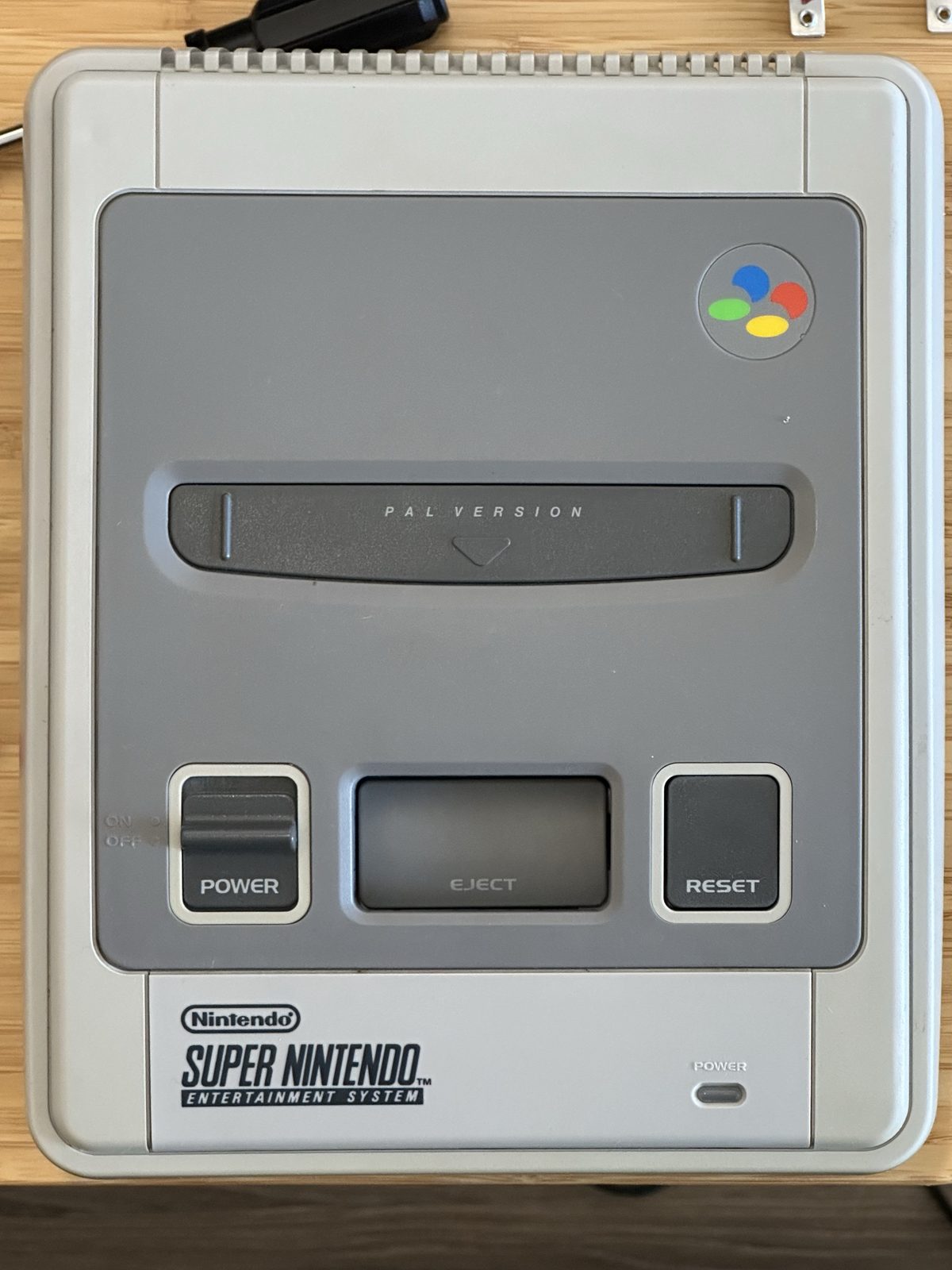
The SNES was Nintendo’s 16-bit follow-up to the NES, and it’s one of those consoles where the library alone justifies keeping a unit around. Mine turned out to have more going on inside it than I expected — full story in my PAL SNES power writeup.
What it is
Released in Japan in 1990 as the Super Famicom, then in North America (1991) and Europe (1992) as the Super Nintendo Entertainment System. Same core hardware across regions, but different shells, different cartridge shapes, and region-locking that isn’t always as clean in practice as the labeling suggests.
Why I like it
The library is the whole case: platformers, JRPGs, and Nintendo’s own first-party output at a genuine peak. Beyond the games, the hardware has real character of its own — Mode 7 background scaling and rotation gave the SNES tricks the competition didn’t have, and the SPC700/S-DSP sound chip still sounds distinct today. The shoulder-button controller shape it introduced is one Nintendo (and everyone else) has never really moved away from.
Pros
- one of the best 16-bit game libraries ever assembled
- Mode 7 and the SPC700 sound chip gave it a genuinely distinct technical identity
- the shoulder-button controller shape is still influential today
- simple, reliable hardware that’s easy to keep running decades later
Cons
- composite/RF video by default — a clean picture means an RGB or component mod
- region-locking (and the hardware that implements it) can complicate an import console
- cartridge prices for some JRPGs have gotten seriously expensive
Related on this site
- I Just Wanted to Power My PAL SNES in America… — a reverse-polarity power supply and a stealth region-free mod
- Plugging a SNES Directly Into a VGA Monitor Actually Works
