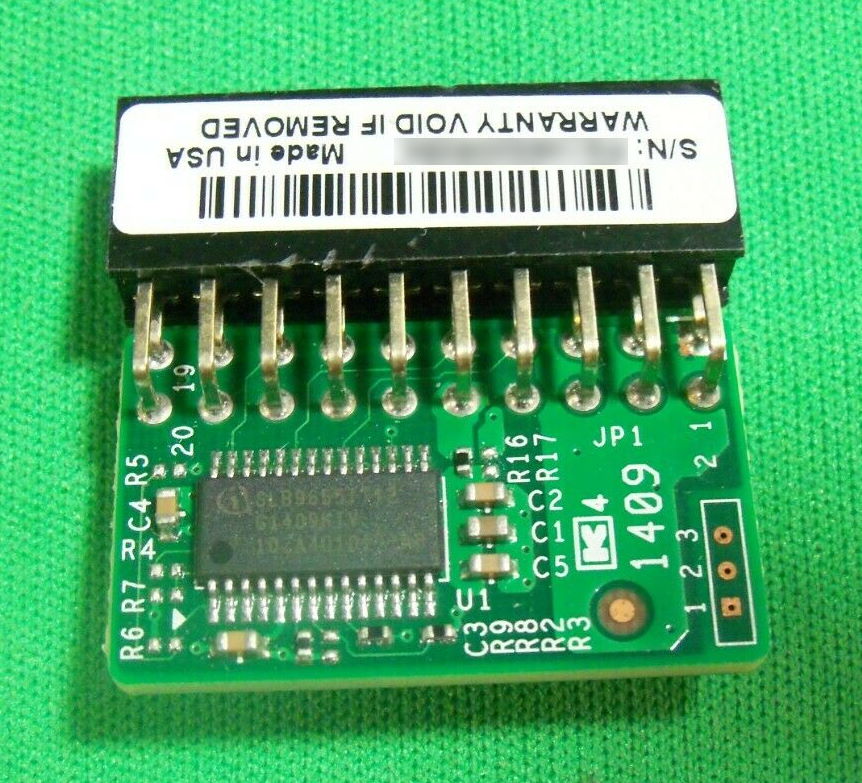
A Trusted Platform Module is a small security chip that handles key storage and system-integrity checks. Windows 11 requires one, which sent a lot of people — me included — rushing to buy a discrete module for an older motherboard.
Discrete vs firmware
- Firmware TPM (fTPM) — built into the CPU. Intel Skylake (2015) / AMD Zen+ (Ryzen 2000) and newer usually have one; you just enable it in the BIOS (Intel PTT / AMD fTPM).
- Discrete TPM — a physical chip, either soldered to the board or plugged into a TPM header. This is what older boards need.
There are also two specs — TPM 1.2 and the newer, incompatible TPM 2.0. Windows 11 wants 2.0.
Fitting one
The catch with discrete modules is that there is no single header standard. You have to match your motherboard’s header exactly. The common ones:
TPM/FW3.19— 20-1 pin, TPM 1.2TPM-L R2.0— 20-1 pin, TPM 2.0TPM-M R2.0— 14-1 pin, TPM 2.0
For my Asus Z87-PRO I found a matching module for about $7. Before fitting it, the system also needs to be on UEFI with Secure Boot, which meant an MBR2GPT conversion from the old Legacy/MBR install first. After that, fitting the module and enabling TPM in the BIOS got me “The TPM is ready for use.”
Why it wasn’t enough
Two problems remained. My board’s module was only TPM 1.2, not 2.0 — and even with 2.0, Windows 11 also enforces a minimum CPU generation (Intel 8th-gen / Ryzen 2000). My i7-4770K was never going to qualify. The module was, in the end, unnecessary: a registry bypass turned out to be the real answer.