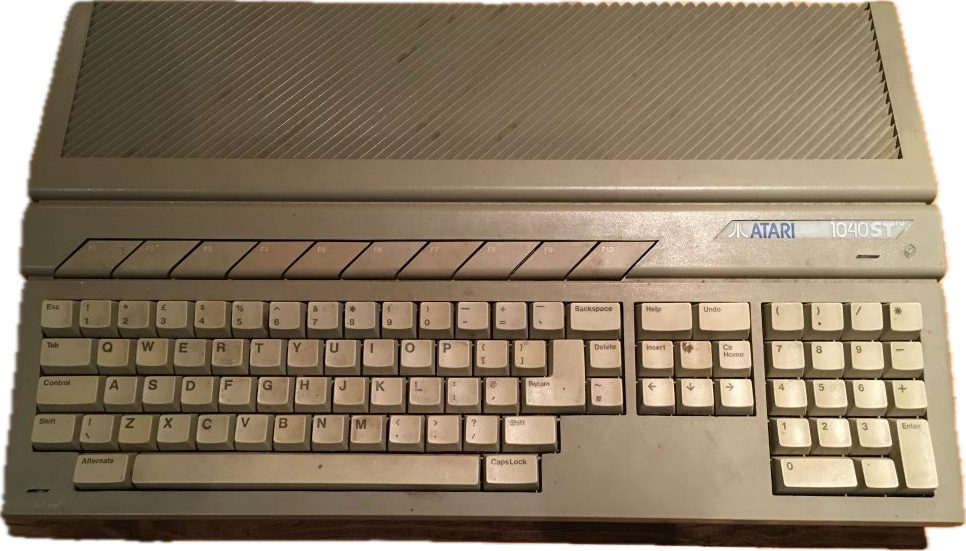
I received my first Atari ST in 1989; a surplus unit from my father’s business. It was a luxury (at the time!) 1 MB model — the Atari 1040STFM, complete with the Professional software pack.
Hooked up to a colour television, I was instantly captivated by the lime-green GEM desktop. I had never used a computer mouse before, and it felt like a huge leap forward from the command-line and keyboard-driven worlds of the ZX Spectrum and the school BBC Micro.
After eagerly clicking through every bundled disk, I was — only very slightly — disappointed to find relatively few games included.
Fortunately, a friend owned the more gaming-oriented Atari ST Power Pack, and before long I was borrowing disks and discovering just how strong the ST’s arcade conversions could be:
- Afterburner
- Black Lamp
- Bomb Jack
- Bombuzal
- Double Dragon
- Eliminator
- Gauntlet II
- Nebulus
- OutRun
- Overlander
- Pac-Mania
- Predator
- R-Type
- Space Harrier
- Star Goose
- Star Ray
- Starglider
- Super Hang-On
- Super Huey
- Xenon
I continued using the ST well into the 1990s, maintaining a subscription to the venerable ST Format magazine — watching it slowly shrink as the platform’s commercial influence waned.
Eventually (like almost everyone else), I moved on to the PC. But those formative years with the Atari ST never really left me.
The Atari ST in Context
The Atari ST line was introduced in 1985 as Atari Corporation’s 16-bit successor to its hugely successful 8-bit home computers. The first model, the 520ST, appeared in limited quantities in mid-1985, with wider availability later that year.
The ST was groundbreaking in several key ways. It was the first mass-market personal computer to ship with a bitmapped colour graphical user interface, using Digital Research’s GEM desktop environment running on top of TOS (The Operating System), which itself was derived from CP/M concepts.
Powered by a Motorola 68000 CPU running at 8 MHz, the ST offered a clean, flat 24-bit address space and performance that compared very favourably with contemporaries — including early IBM PC compatibles and even Apple’s Macintosh, at a significantly lower price.
The Atari 1040STFM
Released in 1986, the Atari 1040ST was a landmark machine. With 1 MB of RAM as standard, it became the first home computer to break the US$1-per-kilobyte memory barrier, an extraordinary achievement at the time.
The STFM variant added:
- An internal floppy drive
- RF and composite video output for use with televisions
- Stereo sound output via RCA jacks
This made it especially popular in home environments, where dedicated monitors were still considered a luxury.
Technical Overview
| Component | Details |
|---|---|
| CPU | Motorola 68000 @ 8 MHz |
| RAM | 512 KB–1 MB (1040STFM standard) |
| Graphics | Low: 320×200 (16 colours) / Medium: 640×200 (4 colours) / High: 640×400 (monochrome) |
| Sound | Yamaha YM2149 PSG (3-channel) |
| Storage | 3.5″ floppy disk drive (720 KB) |
| Operating System | Atari TOS with GEM desktop |
| Ports | MIDI In/Out, joystick/mouse, ACSI (hard drive), serial, parallel |
| Notable Feature | Built-in MIDI ports |
The inclusion of built-in MIDI ports was particularly significant. It helped establish the Atari ST as a dominant platform in music production throughout the late 1980s and early 1990s — a role it retained long after its gaming prominence faded.
Games, Productivity, and Identity
Although often perceived as a games machine — particularly in Europe — the ST occupied a fascinating middle ground. It was equally at home running arcade conversions, desktop publishing software, programming tools, and professional music applications.
Its crisp high-resolution monochrome mode made it well-suited to word processing and coding, while its colour modes powered some of the era’s most impressive home computer games.
For many users, myself included, the ST was a first serious computer — one that encouraged exploration well beyond games.
Looking Back
The Atari ST represents a unique moment in computing history: when graphical interfaces were becoming mainstream, hardware was still approachable, and experimentation felt encouraged rather than abstracted away.
For me, it remains one of the most important machines I ever owned — not just for what it could do, but for what it inspired.
More Atari ST Posts
- Lotus Esprit Turbo Challenge Enhanced for Atari STE - 17 Apr 2021
- Games With MIDI. The Atari ST Never Sounded So Good! - 19 Jun 2019
- Using an SD card and Ultrasatan to Transfer Files from PC to ST - 08 Mar 2016
- Using Ethernet to Transfer Files from PC to ST - 07 Mar 2016
- Using PARCP-USB to Transfer Files from PC to ST - 24 Feb 2016
- Using Serial Cable and ZMODEM to Transfer Files from PC to ST - 13 Feb 2016
- Using Serial Cable and Ghostlink to Transfer Files from PC to ST - 06 Feb 2016
- How to Split and Copy Large Files to Your Atari ST in Chunks - 31 Jan 2016
- Using Floppy Disk to Transfer Files from PC to ST - 30 Jan 2016
- Transferring Files from PC to ST - 26 Dec 2015
- Use Your PC to Create a Bootable Atari ST Game Disk - 22 Sep 2015
- Playing Downloaded Games on a Real Atari ST - 18 Sep 2015
- Atari in the Attic - 15 Aug 2015

